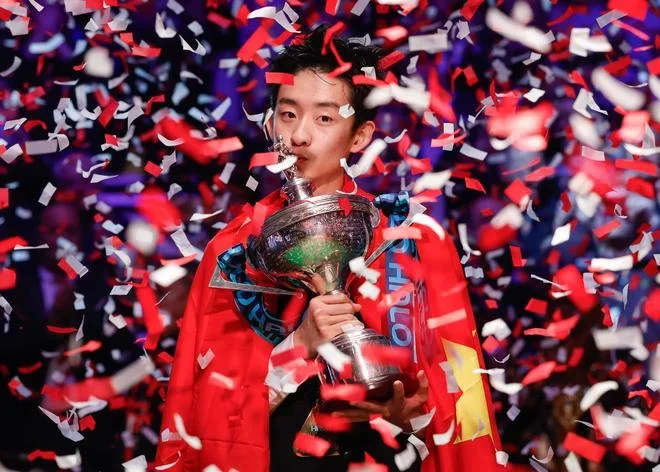

Early on May 5, 2026, Wu Yize defeated Shaun Murphy 18-17 at the Crucible Theatre in Sheffield to clinch his first World Snooker Championship. Following Zhao Xintong’s victory in 2025, Chinese players have now won the prestigious title for two consecutive years, writing a new chapter in Chinese snooker history.
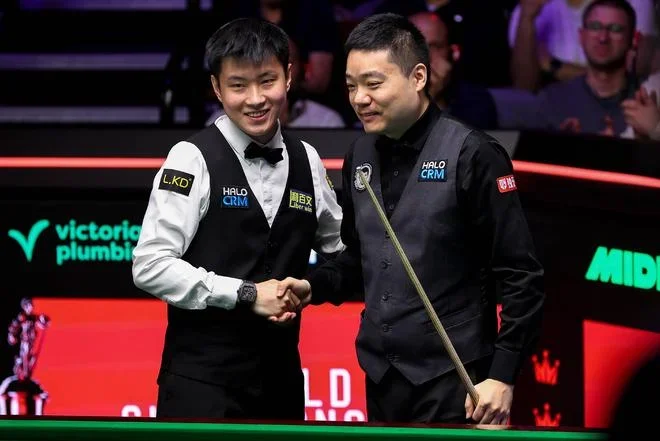
This year’s championship also produced a memorable moment. On April 26, before the round of 16 match, Ding Junhui, Zhao Xintong, and Wu Yize—representing three generations of Chinese snooker—were captured together in the waiting area of the Crucible Theatre. The scene summed up the evolution of Chinese snooker over the past two decades. In 2005, an 18-year-old Ding Junhui burst onto the scene, opening a new era for Chinese snooker. At that time, Zhao Xintong was eight years old, and Wu Yize was not yet two.
Today, Chinese snooker has evolved from Ding Junhui’s solo journey to a collective strength. Whether measured by the number of World Championship participants, youth development, or the growth of the billiards industry, China stands firmly among the top tier. As Ding Junhui noted, “This isn’t just a breakthrough—it’s the arrival of our era.”
On May 4, 2026, at the 2026 World Snooker Championship awards ceremony in Sheffield, England, 22-year-old Chinese rising star Wu Yize claimed the title. (Photo: IC)
**From Solo Breakthrough to Collective Strength: China’s Snooker Talent Pool Deepens**
The World Snooker Championship, UK Championship, and Masters form the sport’s “Triple Crown,” with the World Championship serving as the ultimate honor. Participation numbers at the World Championship reflect a country’s overall depth.
In 2005, only Ding Junhui represented China in the main draw. Over the next two decades, the number of Chinese players in the World Championship main draw typically ranged from two to five, briefly reaching six in 2019. A turning point came in 2025 when 10 Chinese players made history by qualifying for the main draw, culminating in Zhao Xintong’s championship—the first for China and Asia.
This year, China set a new record with 11 players in the main draw, second only to England’s 13. Zhao Xintong, Ding Junhui, Wu Yize, Xiao Guodong, and Si Jiahui qualified through world rankings, while Zhang Anda, Fan Zhengyi, He Guoqiang, Lei Peifan, Pang Junxu, and Zhou Yuelong secured spots via qualifying. In terms of age structure, Chinese players show great promise: of the nine “post-2000” competitors, six were Chinese.
Looking at the 2025/2026 World Snooker Tour season, 32 Chinese players earned tour cards, a record high compared to just eight in 2015. Alongside increasing depth, results have steadily improved. This season, Xiao Guodong, Zhao Xintong, and Wu Yize together won seven titles, the best single-season performance by Chinese players, highlighting their growing collective strength.
Gan Jialing, general manager of billiard table manufacturer Xingpai, told the Beijing News that the success of players like Ding Junhui, Zhao Xintong, and Wu Yize stems from individual talent, hard work, and the steady accumulation of Chinese billiards over the past 30 years. “For Chinese snooker, this is just the beginning. Future Chinese players winning World Championships or other titles will become the norm.”
On April 26, 2026, at the 2026 World Snooker Championship second-round match in Sheffield, England, Chinese player Zhao Xintong shook hands with Ding Junhui after his victory. (Photo: IC)
The collective rise of Chinese players is reshaping the global snooker landscape. During one broadcast, “The King of Snooker” Stephen Hendry remarked, “The sheer number of gifted players emerging from China is frightening.” Six-time world champion Steve Davis added that back-to-back World Championship wins show Chinese players are rising as a group, and their exciting offensive style is redefining the sport.
Snooker traditionally emphasizes safety play and defense, but Wu Yize is not fond of prolonged defensive exchanges. To him, entertainment and competitiveness are equally important, and the sport needs change. “Sometimes the audience finds matches tedious. If we choose to defend for long stretches, we risk losing fan support. I don’t enjoy playing that way either.”
**From Individual Struggle to Systemic Training: China’s Snooker Development System Evolves**
The continuous emergence of Chinese snooker talent is no accident—it reflects the transformation of China’s training system from rudimentary to mature. Ding Junhui’s rise in 2005 marked the beginning of the “Chinese snooker era.” Wu Yize, born in 2003, grew up alongside the rise of Chinese snooker.
Compared to Ding Junhui’s era, younger players like Zhao Xintong and Wu Yize now have access to more advanced training conditions and resources, allowing them to build a solid foundation from a young age. China’s talent development model has moved away from the purely family-supported approach toward a more standardized, systematic system.
Despite improvements in the ecosystem, becoming a professional snooker player remains a long and challenging journey. Both Zhao Xintong and Wu Yize thanked their families after winning titles, with Wu Yize calling his parents the true champions. At age 13, he left school to train in Dongguan, and his father sold the family’s only home in Lanzhou to become his full-time practice partner. For non-Olympic sports, the path to professional snooker is lengthy and uncertain, placing immense pressure on families.
Unlike traditional sports, billiard talent development was initially highly individualistic. Ding Junhui once expressed hope that future players wouldn’t have to face such pressure alone. Over the years, China’s snooker training system has evolved through trial and error, now offering a clear career pathway. Risks once borne entirely by families have gradually been absorbed by standardized youth training systems.
In 2023, ten Chinese snooker players faced bans for match-fixing, including some notable names. Fortunately, China’s comprehensive training system ensured talent reserves across age groups, preventing a major setback for the sport.
Gan Jialing, a veteran industry insider, noted that China’s training infrastructure and institutions are world-leading. Early efforts began in 1995 when Xingpai partnered with Beijing No. 40 Middle School to establish the Beijing Billiard Sports School. In 1996, Beijing Sport University launched a billiard major, pioneering systematic professional training.
Today, training centers like the World Snooker Academy and Ding Junhui Snooker Academy have flourished, creating a complete pipeline from youth development to professional training. “Talent is everywhere, but we need scouts to discover it,” Gan said. “A strong youth training program has cultivated fertile ground for Chinese billiards.”
The rare sight of Ding Junhui, Zhao Xintong, and Wu Yize together at this year’s World Championship symbolizes the passing of the torch in Chinese snooker. Both Zhao and Wu idolized Ding as youngsters, and now these two world champions inspire a new generation, showing them the limitless possibilities of professional billiards. In its congratulatory letter to Wu Yize, the Chinese Billiards Association wrote that his title “will further enhance the competitiveness and influence of Chinese snooker internationally and inspire more young people to take up the sport.”
**From Tournament Systems to Industry Ecosystem: China’s Snooker Achieves a Closed Loop**
The foundation of talent development lies in robust tournament systems and a mature industry ecosystem.
In March 2026, the Chinese Billiards Association unveiled a new tournament structure encompassing professional leagues, championships, tours, and grassroots events. Jiang Sh